
Current Esmeralda County VINELink Coverage
VINELink is historical branding in Nevada. The Attorney General announced that Nevada S.A.V.E. Notifications began on August 28, 2025, and that VINE search and notification ended the next morning. Current searches belong at Nevada S.A.V.E., not in an old VINE workflow or app.
The statewide system receives information from participating Nevada sheriffs, NDOC, the Department of Public Safety, and the Parole Board within statutory funding. It can cover a person in Nevada custody or under supervision, including custody-status events such as release, transfer, and escape. It is not a substitute for the BOP locator, ICE detainee locator, or a federal court record.
Esmeralda County does not publish an official jail roster or release feed on the reviewed Sheriff site. S.A.V.E. can therefore be a useful one-person notification lead, but the Sheriff's booking or release entry remains the local event record. For an NDOC prisoner, use the state offender portal and release data to corroborate a S.A.V.E. notice.
Search One Esmeralda County Person in S.A.V.E.
Use the strongest identifier available and compare every match carefully. A common name can produce several people, and a spelling variation can conceal the intended record. The current form requires CAPTCHA, so it is designed for a person-by-person check rather than bulk access.
- Open Nevada S.A.V.E. and choose the public offender search.
- Enter the full name in first-name then last-name order, or enter an offender ID.
- If spelling is uncertain, try the first three letters of the first name, a space, and the first three letters of the last name.
- Complete CAPTCHA and review the returned matches.
- Compare identifiers and custody or supervision information before selecting a record.
- Register on the intended record if a notification option is offered.
The system warns that people no longer in custody may not be included. A blank search is weak evidence and cannot prove release. For a broader records workflow, use the Esmeralda County released inmate search guide to pair the notification lead with the Sheriff, court, or NDOC record.
The official search screen shows the current name-and-ID workflow:
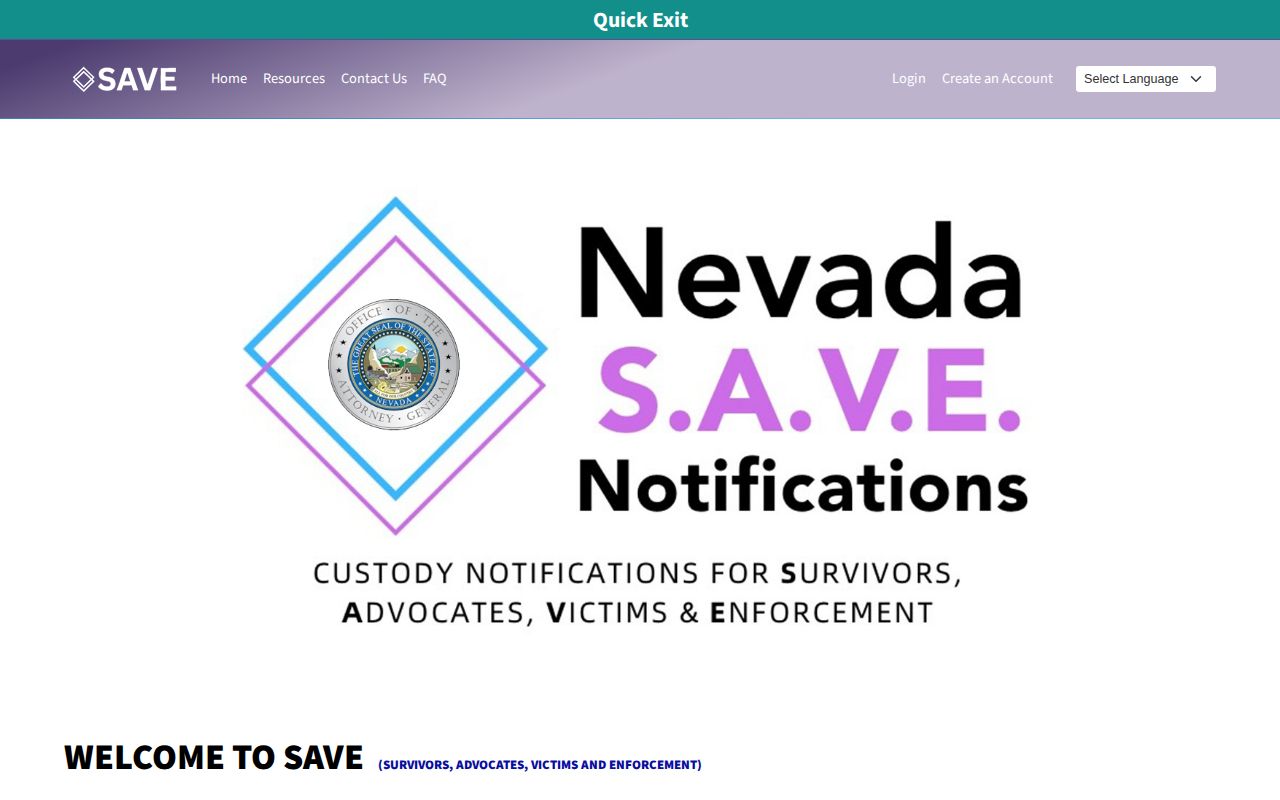
This screen confirms that Nevada's current public route is S.A.V.E., even when a user begins by searching for VINELink.
What Esmeralda County Release Alerts Establish
S.A.V.E. is event oriented. Its value lies in pointing to a change that should be checked with the agency responsible for that event. Exact fields depend on the participating source and record.
| Item | How to read it |
|---|---|
| Name or offender ID | Identity lead that must be matched before relying on the status |
| Custody or supervision status | Periodic statewide information, not a certified record |
| Release event | Prompt to request the originating agency's actual release entry |
| Transfer event | Indicates another custodian may hold the person; it is not community release |
| Escape event | A custody change, not lawful release |
| Notification timestamp | Time the alert was sent, which may differ from the event time |
A S.A.V.E. alert does not explain every legal consequence. Release may be followed by probation, parole, another hold, or a later return to custody. Transfer means the search must continue with the receiving jail, NDOC, USMS, or ICE as applicable. Save the exact event wording and timestamp, then reconcile them with the custodian's record.
Register for Esmeralda County Release Notifications
Registration may be available with or without an account where the offender record permits it. An account provides settings and contact-method management. Registration is confidential, and the public form says only an email address is required if the registrant wants to remain anonymous.
- Find and verify the intended offender record.
- Select the notification or registration option shown for that record.
- Choose SMS, phone, TTY, or account email as available.
- For an account, provide the required email and create a compliant password.
- Select a security question and answer, then state whether an advocate is registering for someone else.
- Confirm the account and review blackout or off-hours preferences before saving.
The current S.A.V.E. account process does not document the old four-digit VINE PIN. Do not create or enter one for the current service. Password, security question and answer, and the selected contact methods now support account confirmation and access.
The official registration page illustrates the account fields and notification choices:
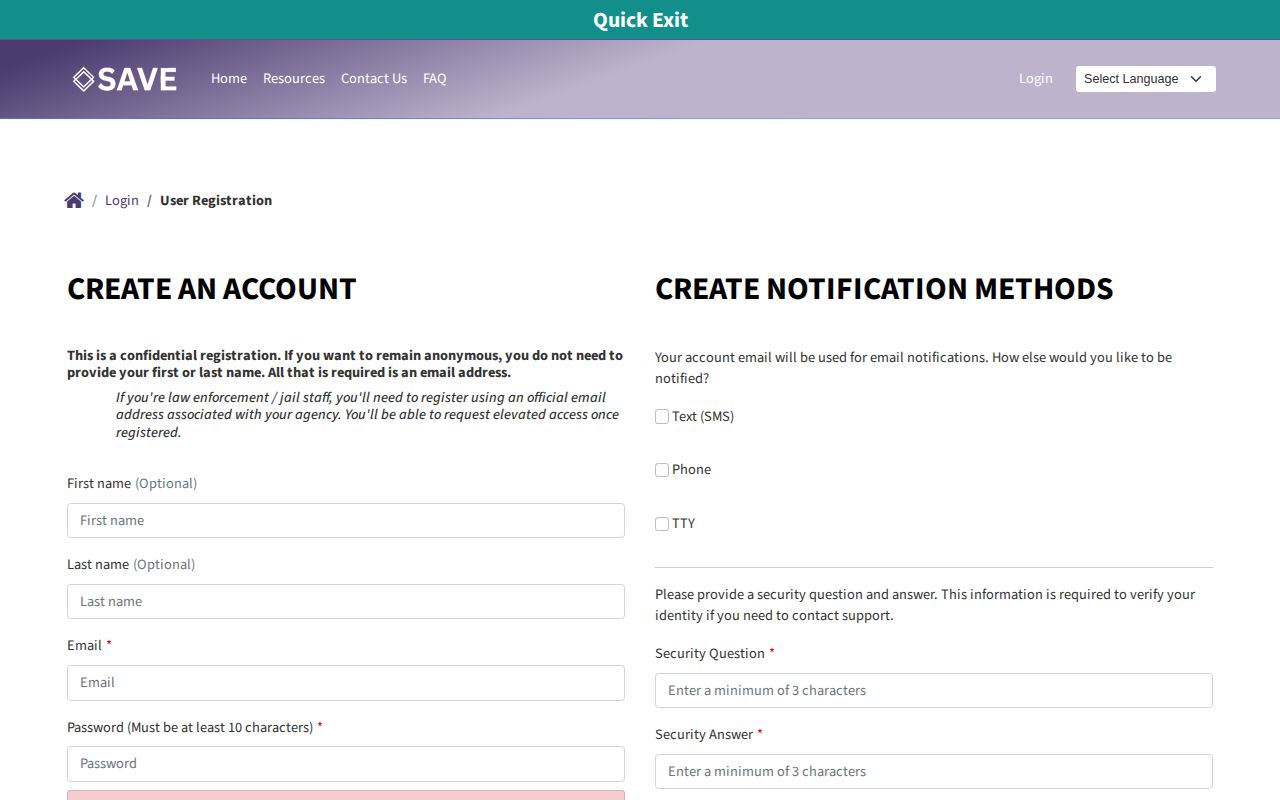
Those choices let a registrant control delivery, but they do not change the underlying agency record or guarantee instantaneous reporting.
Limits of an Esmeralda County VINELink Check
S.A.V.E. says its information is periodic and not an official record. A recent event may not yet appear. A person who has left custody may disappear from public search even though an existing registration remains active. A missed alert therefore does not prove that no release or transfer occurred.
For an Esmeralda County jail episode, ask the Sheriff whether the departure was community release or transfer and request the booking or release entry. Compare the result with the relevant court order. For a state-prison episode, match NDOC Offender ID and inspect Institution, sentence status, and the actual Release download. NDOC's PED, MPR, PEXD, and RRD fields are not interchangeable with an actual release event.
Federal and immigration custody require separate systems. The BOP locator can show a release date and a location or “Not in BOP Custody,” but that result is agency specific. ICE ODLS covers certain current detainees and released people for a limited recent period. Neither system is supplied by S.A.V.E., and leaving one custodian does not prove freedom from all custody.
Why Nevada VINELink Guidance Changed
Nevada's transition occurred across August 28 and 29, 2025. VINE registration was disabled as S.A.V.E. began, then VINE searching and notifications ended. Most registrations were transferred, but people registered only through the VINE App were instructed to register again. Old app status should not be assumed to have migrated.
S.A.V.E.'s offender-based design lets a registration persist across incidents, which can be helpful when a person returns to custody. It also creates a subtle search limit: the public offender result may disappear after custody while the registration continues. That is why a no-result and a live notification enrollment can coexist.
The Attorney General's transition announcement documents the change:
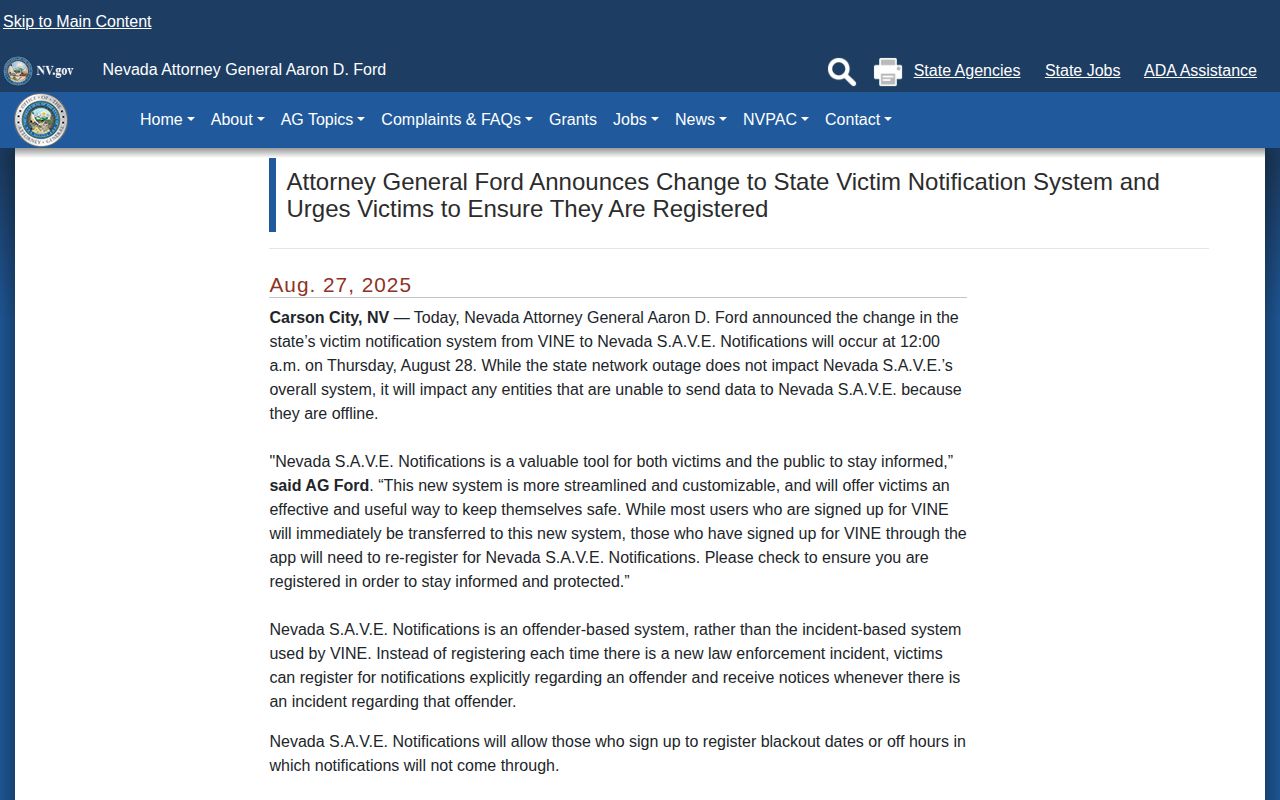
The notice is the reason current Esmeralda County guidance uses S.A.V.E. while retaining VINELink only as a historical search phrase.
Esmeralda County S.A.V.E. Notification Support
When registration, delivery, or account access fails, use S.A.V.E. support instead of interpreting silence as a custody result. Telephone support is available around the clock at 866-393-5445. Email support is NVSave@ag.nv.gov, with a stated response target within three business days.
Have the offender record details, notification method, approximate alert time, and a concise description of the problem ready. Do not send more personal data than support needs to locate the registration. For the release itself, return to the Sheriff, NDOC, court, BOP, or ICE record that created the event.
A failed notification can have several explanations that are separate from custody. An old phone number, blocked automated call, changed email address, account preference, or VINE App-only registration may prevent delivery. Review the chosen methods and transition status before asking the custodian to explain an alert problem. The custodian verifies the event, while S.A.V.E. support addresses registration and delivery.
Reconcile an Esmeralda County Release Alert
Build a short event timeline when several sources disagree. Record the exact S.A.V.E. text and alert timestamp. Then note the Sheriff's release or transfer time, the court order date, and any NDOC booking or release event. A Sheriff's transfer entry followed by an NDOC admission shows continued custody. A community-release entry paired with a court's time-served disposition supports a different result.
For parole, a monthly eligibility-list entry means NDOC anticipated eligibility and scheduling. A hearing schedule means the matter was set. A Board action records a decision. None alone confirms physical release. Institution=PAROLE plus an actual NDOC release event supports the later move to community supervision. Final discharge requires another official document.
If the sources still conflict, report the conflict with each source date and ask the agency that created the disputed event. Do not choose the result that appears newest or most favorable merely because it is easier to find. Periodic notification data and raw NDOC downloads can update at different times.
Identity deserves a separate check. Use a full legal name, documented alias, date of birth, local case or booking number, and NDOC Offender ID when available. Avoid copying extra personal details from a result. The goal is to establish that the alert concerns the intended person, not to reproduce a complete profile.
For a very recent Esmeralda jail change, ask one binary question first: was the departure release or transfer? If it was release, ask for the event time, category, authority, and any other hold. If it was transfer, ask for the receiving custodian and continue in that agency's system. This prevents “left the jail” from becoming an unsupported claim that the person returned home.
For an older alert, the court file may be the most durable starting point. Its docket can identify the case, disposition, and signed release authority, which in turn helps the Sheriff or NDOC locate the matching custody event.