
Esmeralda County Parole and Probation Compared
Parole and probation both allow a person to live outside a jail or prison while following enforceable conditions, but their legal starting points differ. Nevada parole follows an NDOC prison sentence. The person serves the balance of that sentence in the community under the jurisdiction of the State Board of Parole Commissioners and supervision of the Division of Parole and Probation. Probation comes from a court judgment, often when the judge suspends a prison term and orders community supervision.
| Question | Parole | Probation |
|---|---|---|
| What starts it? | Release from an NDOC prison after Board action and plan approval | A sentencing court's judgment and probation order |
| Best first public record | NDOC result, actual release event, and Board action | Court docket, judgment, and signed probation order |
| Does it mean custody ended? | Prison custody ended, but the sentence and supervision continue | Jail or prison may be avoided or ended, while court supervision continues |
| What proves completion? | Official parole discharge under Nevada law | Official probation discharge from the court |
PAROLE points to community parole, not a prison location and not final discharge.A court can also impose probation after a local Esmeralda case without any NDOC incarceration. That is why an NDOC no-result does not rule out probation. Conversely, a Board action granting parole does not establish that the person has physically left prison. Each record must be read for the event it actually documents.
Verify Esmeralda County Post-Release Supervision
Begin with the case type and the last known custodian. A person sentenced to NDOC follows the parole path. A person placed on probation in an Esmeralda court follows the court-record path. Using a full legal name, documented alias, date of birth, case number, or NDOC Offender ID reduces the chance of joining records for two people.
- For parole, search the official NDOC offender portal by Offender ID or name and read the update stamp.
- Look for Institution=
PAROLE, status=Paroled, and an actual release event. Do not substitute PED, MPR, PEXD, or RRD for a completed release. - If parole was considered, compare the monthly eligibility list, hearing schedule, and Board action. Each represents a different stage.
- For probation, ask the correct Esmeralda court clerk for the docket, judgment, signed probation order, and later discharge record.
- Call Nevada P&P headquarters to identify the active field office before traveling or attempting to report in person.
- When final completion matters, obtain the official parole or probation discharge document rather than calculating from an expected end date.
NDOC describes its portal material as raw data rather than an official record. The release data are useful corroboration, but an official NDOC response is stronger when the exact custody-to-supervision transition is disputed. For probation, no official statewide public adult P&P name search was identified. Direct confirmation may be restricted, so the filed court documents are the durable public trail.
Esmeralda County Supervision Office Routing
Nevada's official directory places Esmeralda County in Northern Command, but rural routing requires a call before a visit. The directory marks the former Tonopah office at 1137 S Erie Main, Suite B-4 as closed and does not name an Esmeralda replacement. Proximity alone does not establish that Pahrump, Ely, or Carson City holds the assignment.
Nevada Division of Parole and Probation Headquarters
1445 Old Hot Springs Road, Suite 104
Carson City, NV 89701
Phone: 775-684-2600
Ask which active field office handles the particular Esmeralda County supervision case before traveling.
The official P&P contact directory is the source for current command and office listings. An office can handle reporting and case administration without making an individual's confidential supervision file public. The purpose of the call is accurate routing, not a promise that staff will disclose protected case details.
The state directory image shows the Northern Command routing and closed Tonopah listing:
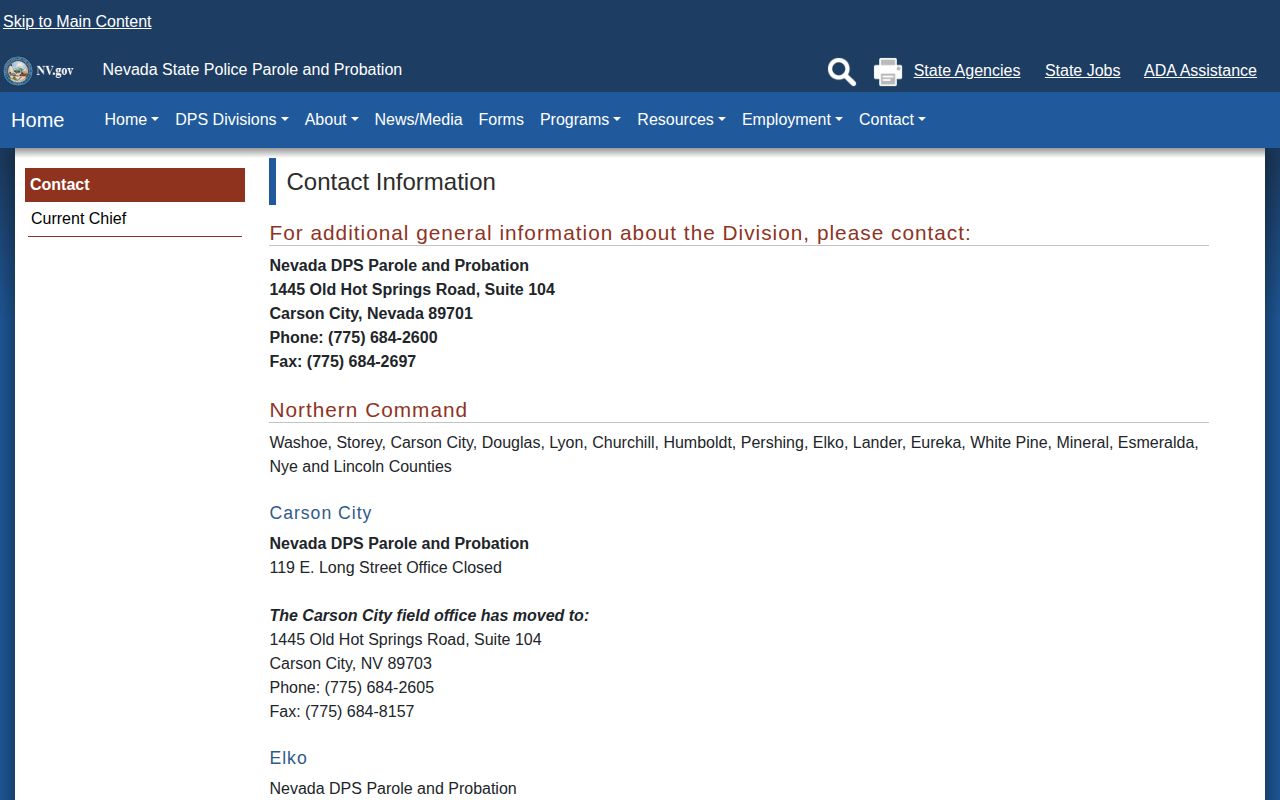
That listing supports calling headquarters before travel instead of assuming the closest rural office handles the case.
Esmeralda County Supervision Violations and Warrants
Conditions come from the controlling parole certificate, probation order, and later modifications. They can govern reporting, travel, programs, contact, and other conduct, but the exact terms must be read from the person's record. A violation allegation is not a final finding. It may lead to a hearing, modification, revocation process, warrant, or return to custody depending on the authority and facts.
No Esmeralda County absconder list or official statewide public P&P absconder search was located. An absconder notation does not prove where the person is, and a warrant does not mean the person is currently held. Verify a warrant with the court or law-enforcement agency that issued it. Verify physical custody with the jail or prison that would hold the person. Nevada S.A.V.E. may produce a supervision or custody-change lead, but its periodic data are not an official record.
How Esmeralda County Supervision Ends
Physical release and final discharge happen at different points. A person on parole remains under the sentence after leaving an NDOC institution. Nevada law provides parole discharge documentation under NRS 213.154 and 213.155. A Board early-discharge agenda shows that a case was scheduled for consideration, while the resulting action and official discharge document establish what happened.
Probation completion also requires a record. NRS 176A.850 provides for an official probation discharge document and a route to replace lost documentation. The apparent passage of a calendar term is not enough because an extension, violation, tolling issue, early discharge, or dishonorable discharge can affect the endpoint. Request the filed discharge from the sentencing court.
The Esmeralda County released inmate search and records guide explains how to pair a supervision record with the earlier jail, court, or NDOC release event. Keeping those stages separate prevents a common error: treating release to supervision as proof that every legal obligation has ended.
NDOC Reentry for Esmeralda County Releases
NDOC operates a statewide Re-Entry Program that begins at intake and can continue through community release, transitional placement, parole, or probation. For a person leaving an NDOC institution after an Esmeralda sentence, reentry planning and the approved parole plan can affect the timing and location of community placement. Plan approval is one reason a favorable Board action may precede physical release.
This is a state corrections program, not proof that Esmeralda County operates its own reentry office or placement program. County-jail release and NDOC reentry are distinct paths. A local detainee who returns directly to the community should use the Sheriff's release entry and court order to establish that event. An NDOC prisoner should use the state release event, Institution status, and supervision office routing.
Property and ID After Esmeralda County Release
Two Nevada jail rules give people practical anchors after a county release. NRS 211.380 requires the sheriff to return valuables and pay the remaining individual-account balance when a person is released, with full and accurate accounting. Esmeralda publishes no separate property-counter instructions, so questions about a missing item or balance should go promptly to the Sheriff's office with the person's identity and custody dates.
NRS 211.2405 permits a sheriff to give eligible people released at term expiration information and reasonable help with identification documents when requested and after document verification. The statute does not prove that Esmeralda runs a named local program or that every release qualifies. Ask the Sheriff what assistance was available for that particular custody episode.
These property and ID steps are release logistics, not evidence of parole or probation status. Use the supervising record to determine conditions and the jail record to resolve property or account questions.
Closed Tonopah Office and Esmeralda Reporting
The closed Tonopah listing is a material rural-access detail. An old document, map result, or remembered reporting location can send someone to an office that no longer operates. The current P&P directory does not identify a replacement specifically for Esmeralda County, so there is no sound basis to name the nearest office as the assigned one.
Call headquarters at 775-684-2600 and ask for the active office that serves the case. People subject to supervision should follow their written instructions and contact their assigned officer through the approved channel. A public directory helps with routing, but it does not amend a reporting condition or excuse a missed contact.
When an old court paper names Tonopah, preserve the paper and its date, then verify current routing. The closed-office notation may reflect an administrative change rather than a change in supervision itself. Headquarters can identify the live office, while the sentencing court or Parole Board record explains the legal basis for supervision.
Keep the questions narrow. Ask where the case is administered, which public contact channel is current, and which office holds a record request. Staff may decline to discuss an individual's protected case details. That limit should not be interpreted as proof that supervision ended.